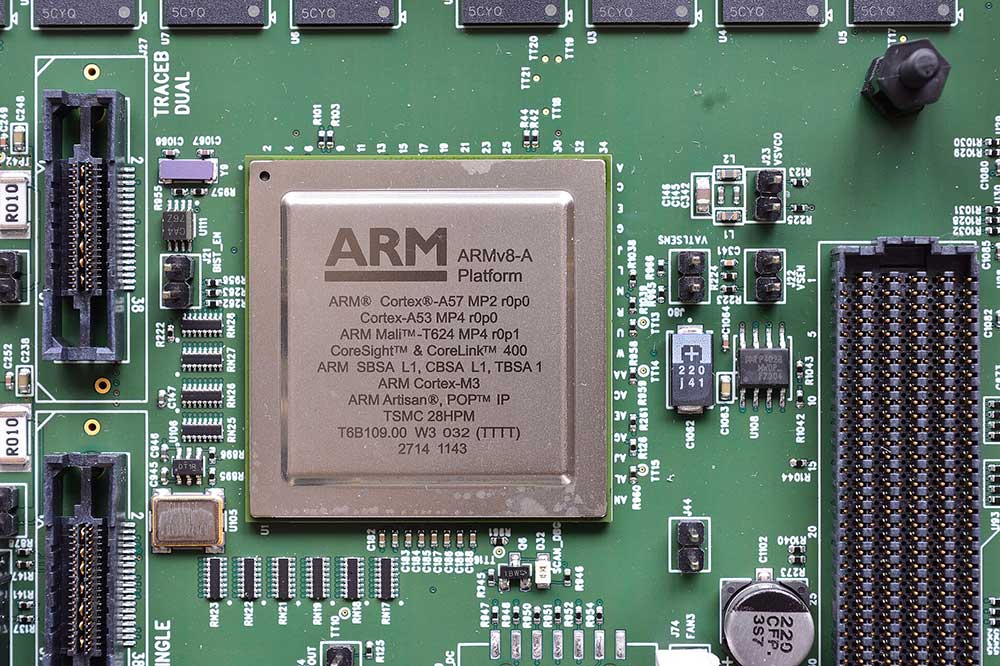
There have been a lot of developments and announcements related to ARM based processing, and it is worth diving into what that means when examining the direction that digital content creation is moving. At the beginning of 2020, x86 processors ruled the marketplace. Both Windows and MacOS ran exclusively on x86 processors, Playstation and XBox systems were both x86 based, and most Windows and Linux servers were x86 based. The x86 name is based on Intel’s CPU naming in the 90s, the 286, the 386, and the 486. Pentium would have been the 586, but courts determined that Intel couldn’t trademark a number, so we have had name based branding since then: Celeron, Xeon, Centrino, Core, etc. AMD and other clones used the same instruction sets, to be compatible with programs designed to run on Intel CPUs, so that form of instruction set came to be known as x86 compatible. The main alternative is ARM, which is what all Android phones are based on, and now many other things. ‘ARM’ stands for Advanced RISC Machine, and ‘RISC’ stands for reduced instruction set computing. Reduced instruction set means to break complex instructions down into smaller simpler tasks before processing them, and is just a different approach to handling the complex computations that computers are used for.
 Apple switched to their own Apple Silicon processors, which were ARM based, starting in 2020 with the M1 chip. Now all current MacOS systems are running on ARM chips, and this led software companies like Adobe to recompile their software to execute natively using ARM instructions on MacOS, instead of having every x86 instruction interpreted to ARM through Apple’s Rosetta software. ARM is a more energy efficient CPU architecture, but it took a long time to develop it in ways for the overall performance to scale as high as x86 systems. That is why it started in cell phones, where run time is more important than total processing power, and then moved to tablets, and then laptops, like the MacBook Pro. Desktops were the last thing to make the jump to Apple Silicon, and whether they can compete with x86 CPUs on the high end is still debatable. Apple has had trouble scaling up for their Ultra chips, and totally dropped their Mac Pro line, because they couldn’t make anything faster than the Mac Studio. But once the applications were recompiled and released for native ARM processing, Apple laptops got huge battery life boosts, even while doing fairly processing intensive tasks.
 The next year, NVidia released their Grace CPUs to pair with their GPUs on the server side, as previously their server GPUs were connected to x86 CPUs via PCIe buses. It is easier to switch a server architecture over from x86 to ARM, because most servers are only running a couple services, but to a large number of users. Desktops on the other hand, usually serve one user, but with lots of different potential programs, each of which has to be compatible with the CPU architecture chosen for that system. The peak performance limitations of the ARM design continued to be a factor, but NVidia had found a way to get at least the performance they needed to support their GPUS on the server side. When NVidia announced Grace CPUs, I immediately foresaw that content creation workstations would soon be running on ARM processors.
 What I didn’t foresee was that they would still be running Windows as the OS. Microsoft made a first foray into ARM support with Windows RT back in 2012, for Microsoft Surface tablets running ARM processors, but you could only run official Windows store apps on them, and no x86 programs, which was very limiting at the time. But in 2021, Microsoft released an ARM compatible version of Windows 11, and this time it could still run x86 applications (albeit at lower performance) through a Prism emulation layer. Qualcomm had an exclusive agreement with Microsoft that only their (Snapdragon) processors would be supported by Windows for ARM for the first few years, but that period ended in 2024. Now other manufacturers can create ARM systems which could run Windows, and Windows applications.
There are already a surprisingly wide (considering the RT failure) number of ARM native applications, which will make it easier for the rest of the market to develop. Adobe converted Photoshop and Premiere to ARM native a few years ago, which surprised me at the time, since Snapdragon laptops were such a narrow market, but I assumed it must have been relatively easy to do that, after supporting ARM on the Mac side. It is likely that they instead did that because they foresaw a wider selection of ARM systems coming to market in the mid term future.
 That time is now approaching with the upcoming release of NVidia’s Spark RTX systems, which integrate their ARM CPUs with their existing GPU cores, into a single SoC (System On a Chip). The CPU and GPU can share data at huge speeds compared to PCIe connections, and the RAM is shared between them and connected at far higher bandwidths than separate DIMMs. This is similar to Apple Silicon chips (M1-M6) and the Intel Lunar Lake Architecture, but presumably with much higher peak performance, at least on the GPU side, because that is NVidia’s specialty.
Now on the content creation side, there are already applications like Photoshop, Premiere, and After Effects, as well as DaVinci Resolve, which are ready to run on Windows for ARM. I am looking forward to comparing the performance of the ARM versions with the x86 version on my Intel laptop. It would be pretty great if this was a huge step forward for laptop users. It is less likely to be a huge step forward for desktop users, because desktop systems have less benefit from power efficiency, and currently scale peak performance much higher.
 There is also the gaming angle, since NVidia is also a gaming hardware company, their Spark RTX hardware is designed with that market in mind as well. Steam OS has emerged as an alternative to Windows, leading to numerous games now supporting Linux, which is a relatively new development. And then the release of the Steam Frame headset, which runs on Snapdragon ARM hardware, has further motivated game developers to make their programs native ARM compatible. So there will be numerous ARM native games to run on the upcoming Spark systems as well.
There are likely other ARM manufacturers coming out with Windows compatible products, but I am most interested in NVidia’s offerings, because they have consistently produced the most powerful GPUs in the world, which are integrated to the new ARM systems directly, and because they have the knowledge and engineering resources to potentially make the fastest CPUs in the world as well. So it will be interesting to see how these new products perform once they are released.