Professional Ampere GPUs from NVidia

      No Comments on Professional Ampere GPUs from NVidia

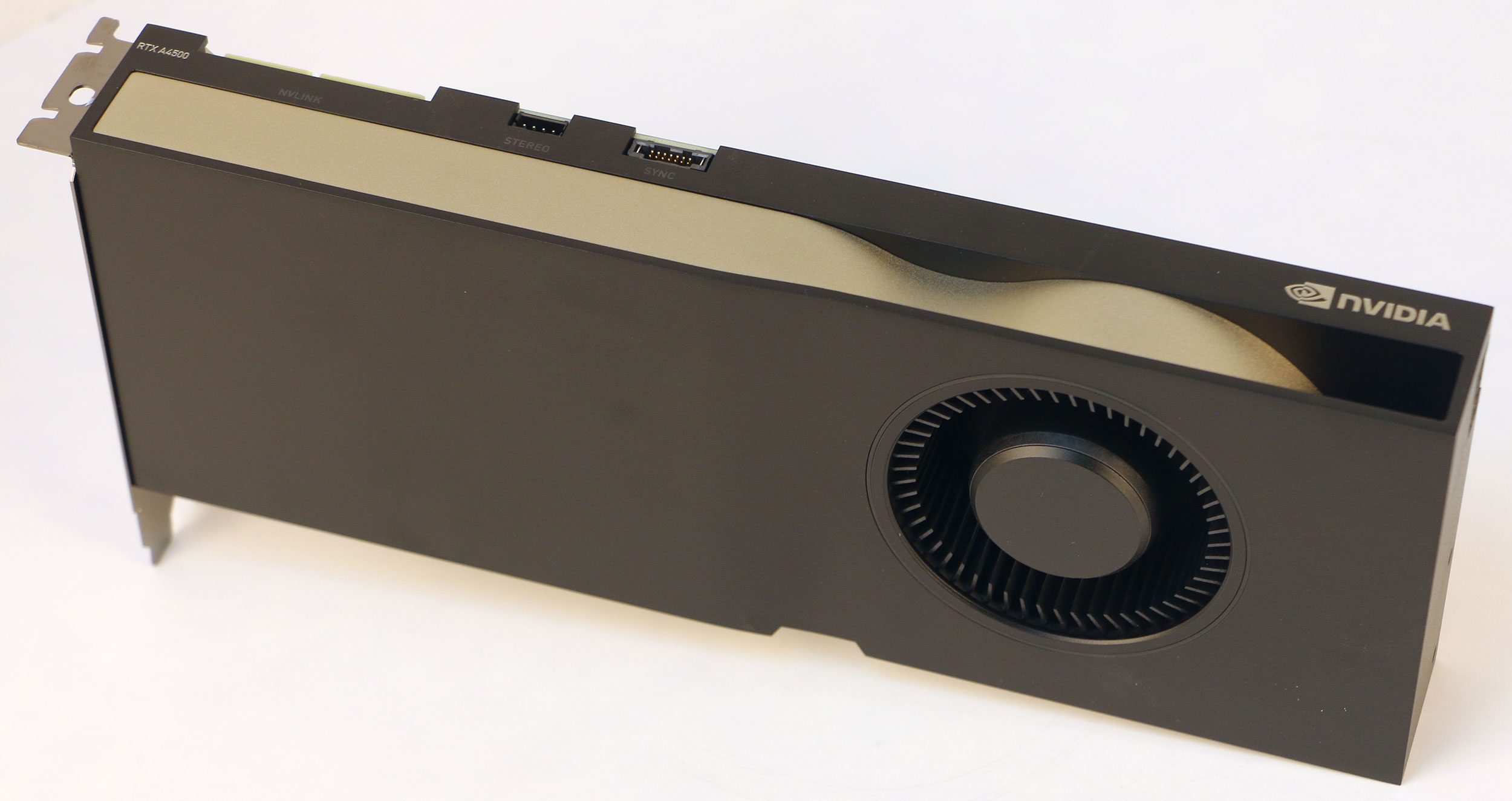
NVidia has quite a long selection of professional GPUs available based on the Ampere generation chips.  While this offers users finer gradations in pricing and performance, it can be more confusing than previous generations, especially since they have dropped the “Quadro” branding.  My understanding is that one of the main reasons there are so many options is not just the binning of chips, but supply chain issues with the rest of the parts on the board.  Unlike gaming cards where a source part can be swapped and a new revision of the card can be produced without much issue, the professional cards that have been certified by software vendors with very precise conditions, need to maintain those exact specifications.  So different versions are created using easier to source parts, and certified again, allowing both cards to be produced as separate options.  The main additions to the series are the A4500 and the A5500, which fit as expected between the existing A4000, A5000, and A6000 cards.  The A4500 which I have been testing, sits nearly dead center between the A4000 and A5000 on all paper specs (cores, memory, teraflops, etc.), while the A5500 nearly matches the A6000 in processing power, but with the same memory limits as the A5000.  While these new cards were announced in the spring, I am finally getting the chance to test one out now.
Continue reading
Boxx’s Apexx S3 – Intel’s Alder Lake Maxxed Out

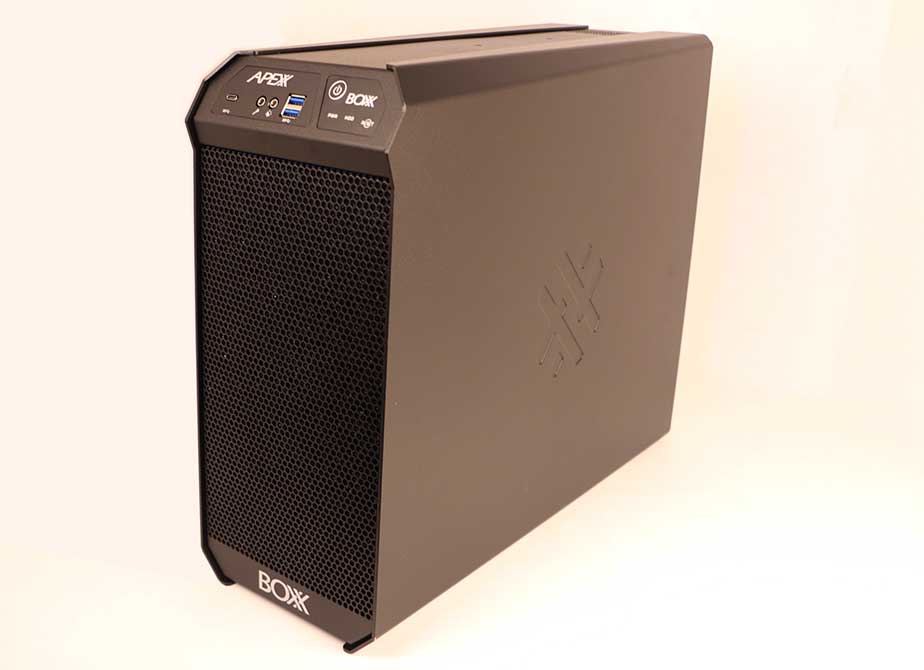
I have spent the last few weeks using Boxx’s newest iteration of their Apexx S3 Workstation, and it is quite impressive. Based on Intel’s “Alder Lake” CPUs, with DDR5, it is technically a workstation built from gaming class hardware, but this just makes it more power efficient and budget friendly. And with a 5Ghz Core i9 CPU and 64GB of RAM, it doesn’t lack in performance.
Continue reading

NAB 2022

      No Comments on NAB 2022

NAB has returned to Las Vegas this week, as an in person event for the first time in three years.  Due to this, there are many new products being announced and launched from all sorts of media related companies.  Unsurprisingly, many of them focus on remote workflows and post, which have been relevant to me since before Covid.  So here is a quick summary of the bits of news that stand out to me.
Continue reading

GTC 2022 – NVidia Isn’t Slowing Down

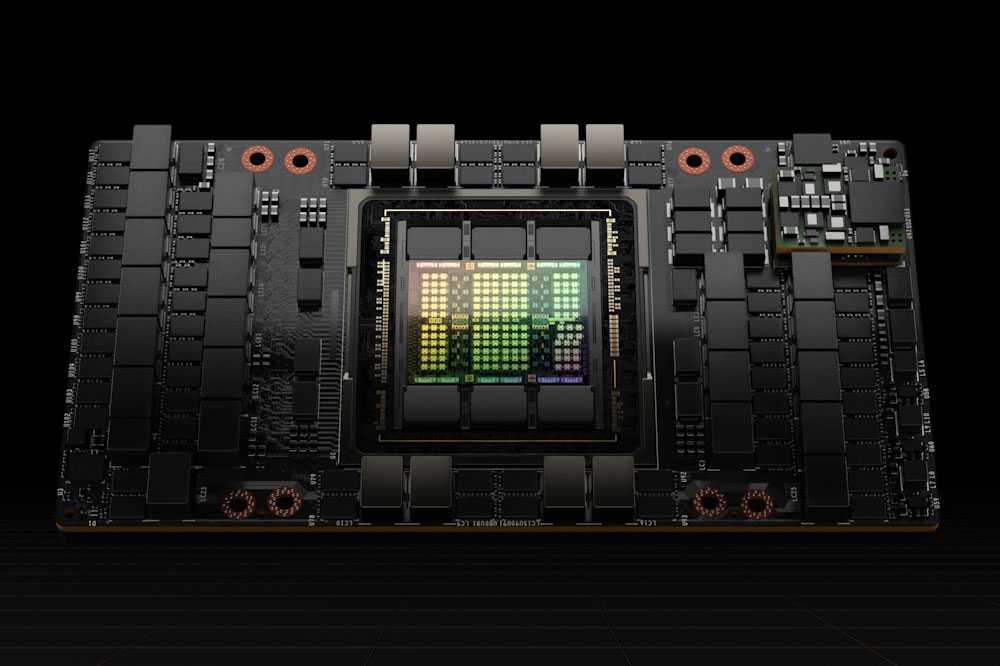
NVidia is hosting GTC 2022 this week, which is mostly focused on supercomputing and AI uses for their graphics processors, but there a few announcements that are relevant to content creators as well.  Indirectly, the new generation of H100 “Hopper” GPUs in NVidia’s new DGX supercomputers give us a look at what may be coming to the next generation of graphics cards later this year.  And the upcoming Grace CPUs may someday bring ARM processors to powerful PCs, the way that M1 chips are bringing ARM architecture to Mac systems.  I don’t know for sure if “Hopper” is going to be limited to supercomputing uses, like Volta was, or will become the basis for the next generation of graphics cards.  But with 60 TeraFLOPS of processing power, it could eventually support GPUs with 50% more performance than the current A6000.  And with a peak 700W TDP in its current SXM form factor, we see why higher wattage power connectors are coming to market in preparation.
Continue reading

Finding the “Best” Workstation

      No Comments on Finding the “Best” Workstation

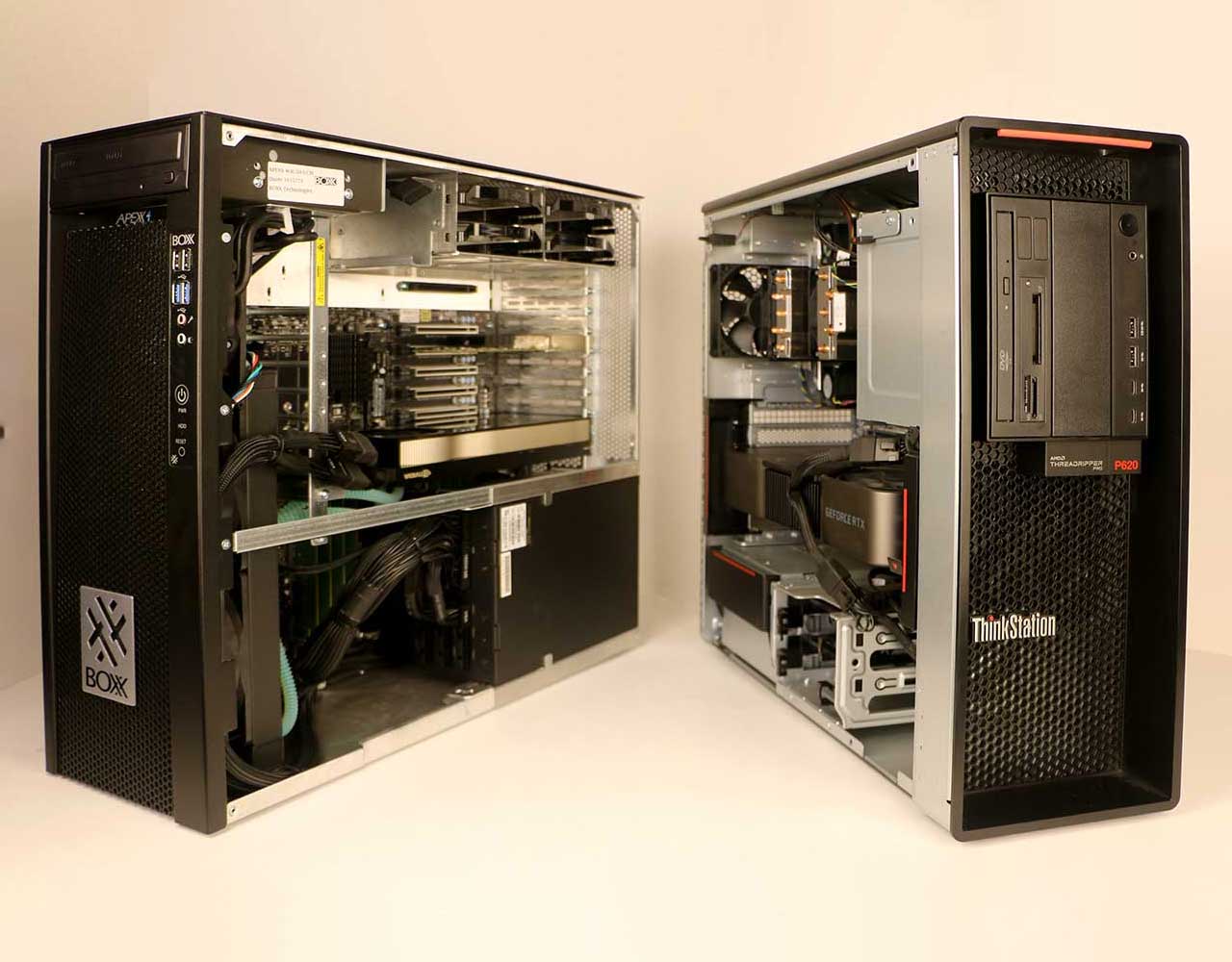
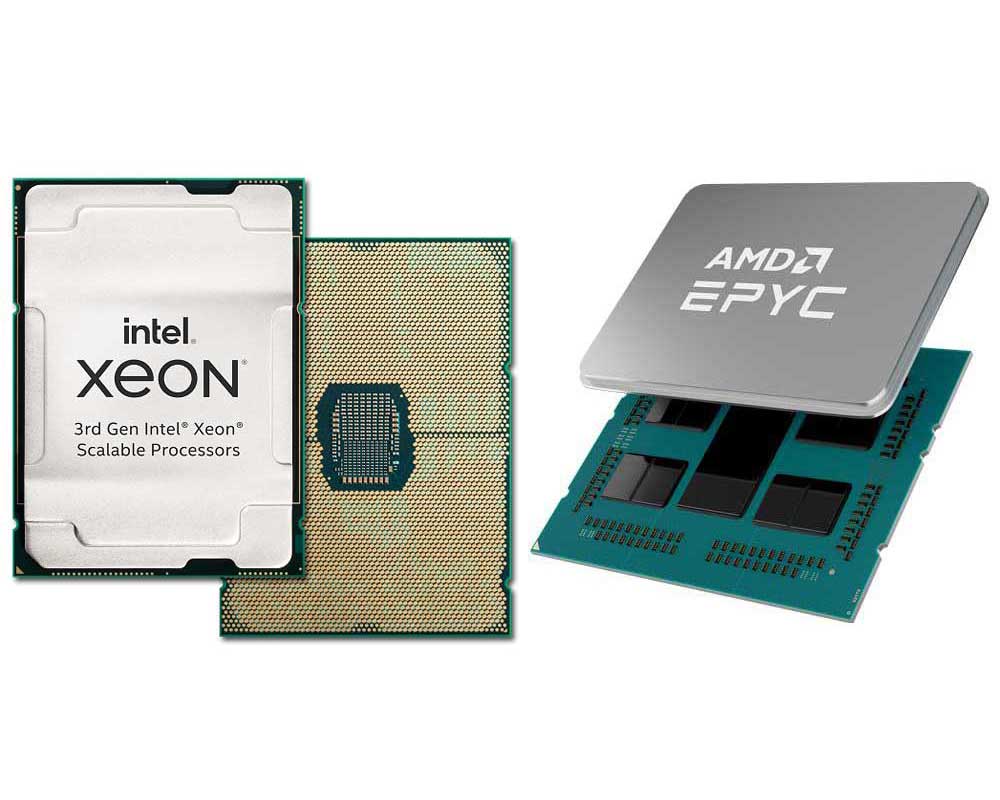
I have had the unique opportunity to test the two most powerful single socket workstations available  on the market today.  Last year’s review of the Lenovo Thinkstation P620 looked at what is still the only new desktop workstation to be released by a major system vendor since 2017.  It’s Threadripper Pro 3995WX 64 core processor is the pinnacle of AMD’s Threadripper CPU lineup, and the only Threadripper based system available from a major manufacturer.  More recently I have had the opportunity to test out Boxx’s Xeon W 3300 based Apexx Matterhorn workstation.  With 38 Cores, 8 channels of memory, and 64 PCIe lanes, the Xeon W 3375 processor is the single socket version of Intel’s newest “Ice Lake” Xeon chips. Continue reading

The End of Dual Socket Workstations?

      No Comments on The End of Dual Socket Workstations?

High-End Computers and Workstations
I have always been a fan of top end computer systems.  Truth be told, the reason I originally got involved with digital video production back in high school, was because it was the coolest thing you could do with computers.  Multi-processor systems have fascinated me since I ordered a dual socket Pentium3 motherboard from the Tiger Direct catalog in 2000.  I have had the opportunity to use a lot of the fastest systems that were commercially available over the last two decades, as I continued to find myself on projects that pushed the envelope of what was currently possible in video and post production.  For many years, I would never have considered using anything less than a dual socket workstation, with the most powerful processor available.  But that is no longer the case, and not because I am not longer using cutting edge workflows, but because of changes in how computers are designed and marketed.
Continue reading

Hardware Accelerated HEVC in Premiere Pro

      No Comments on Hardware Accelerated HEVC in Premiere Pro

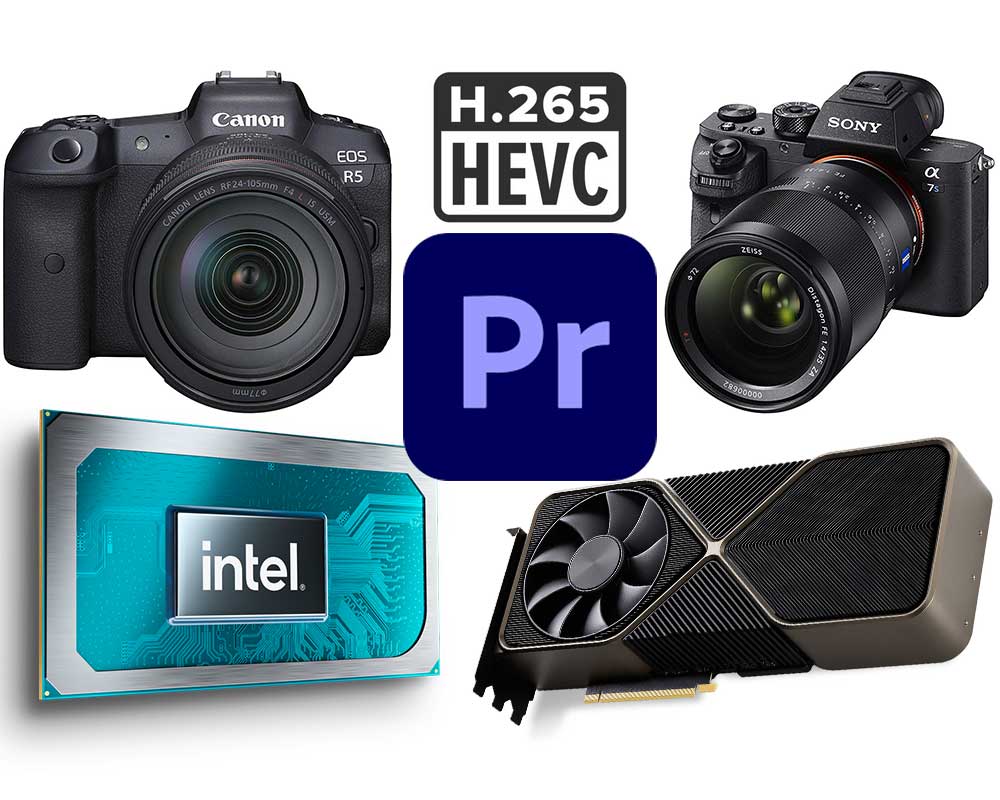
The High Efficiency Video Codec (HEVC) or H.265 is a very processing intensive codec for both encode and decode, but leads to higher video quality at lower data rates.  There have been both CPUs and GPUs available for years that have dedicated hardware within them to accelerate HEVC encoding and decoding.  But this hardware acceleration requires specific support within software applications to utilize them.  And unlike with software encoders, there are a finite number of supported encoding options that can be accelerated, each of which has to be explicitly supported.  The newest updates to Premiere Pro have greatly increased the number of hardware accelerated options for HEVC workflows, greatly increasing performance with those types of files.
Continue reading

Reviewing BOXX’s Apexx Matterhorn

      No Comments on Reviewing BOXX’s Apexx Matterhorn

BOXX’s APEXX Matterhorn system is based on Intel’s Xeon W-3300 CPU architecture, and C621A chipset, and it represents the pinnacle of Intel’s single socket system performance, with up to 38 CPU cores, 8 channels of DDR4 memory, and 64 lanes of PCIe 4.0 connectivity.  The system I am reviewing came configured with the top end Xeon W-3375 CPU, sporting 38 cores, listed as running between 2.5 and 4.0 GHz, with 57MB of cache (1.5MB/Core).  It has 64GB RAM spread across all 8 channels.  The CPU is liquid cooled, and has a 1600Watt power supply, allowing it to support all sorts of power hungry multi-GPU configurations with its 64 PCIe lanes spread across 7 slots.  It also has 4 M.2 slots, one of which came populated with a 1TB SSD.   The system also shipped to me with an NVidia A6000 card in it, which is the top pro-visualization card in their formerly Quadro lineup.
Continue reading

Adobe MAX 2021 and new Premiere Pro Features

      No Comments on Adobe MAX 2021 and new Premiere Pro Features

Adobe’s MAX creativity conference is being held online for the second year in a row this month.  With this comes the release of new versions of many of their products.  One interesting thing worth noting in this regard is that their versioning of each video application is being incremented to version 22, regardless of the previous version.  This will make the version numbers consistent across the different applications, and match the year that the release is associated with.  Last year Premiere Pro 2021 was released, but it was version 15.0, while After Effects was 18.0.  Unlike Adobe’s ridiculous move to redesign their applications icons to all look the same (so you can’t easily tell the difference between an AEP file and a Premiere Project), this broad consistency change seems like good idea to make it easier to track versions across time.
Continue reading

Networking for Post-Exceeding 10Gigabit

      No Comments on Networking for Post-Exceeding 10Gigabit

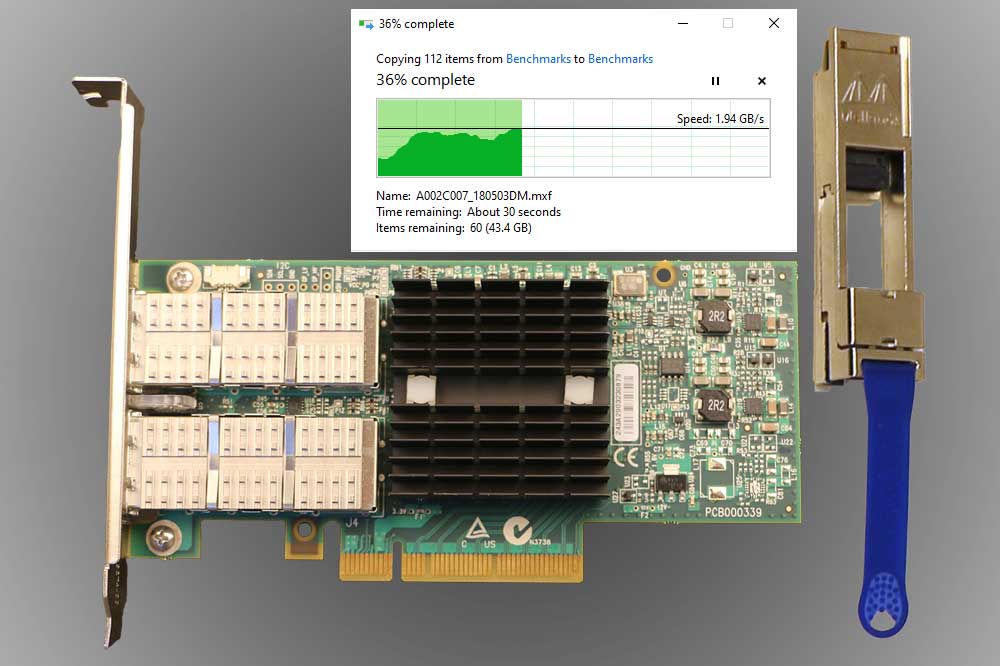
This article wraps up a series where I have been exploring different networking options for exceeding the bandwidth limitations of Gigabit Ethernet.  10GbE has come down in price, and has become more common for post production work over the last few years, but is not quite fast enough for uncompressed 4K at higher framerates, higher resolutions, or multiple streams.  There are technologies that offer bandwidths exceeding 10Gigabits a second, but there is minimal information and familiarity with these options outside the datacenter space.  The original approach was 40GbE, which combines 4 channels of 10GbE in a single connection, while the newer 25GbE standard is based on increasing the signaling frequency of a single connection.
Continue reading